




AARP Eye Center



















































The Takeaway: Reaching Age 90 More Likely Than Ever; Supermodel Carmen Dell'Orefice Still Catwalking at 80
By Elizabeth Nolan Brown, November 18, 2011 09:39 AM
90+ Population Booms: My dad and I were talking this past weekend about perceptions of age: How when you're a teen, 30 is middle-aged and 50 is old; at 30, 50 is middle-aged and 70 is old; and at 50, well ... "I guess now I don't think you're old old until you're 80," my 57-year-old dad said. Will we soon up that age to 90? According to the most recent census bureau data, Americans are more likely to reach 90 than ever before. The number of 90-year-olds in this country has tripled since 1980, to 1.9 million. And this number is only expected to grow with the aging of the boomers and post-boomer generations: By midcentury, 8.7 million people-or one in 10 older Americans-could reach the age of 90. A century ago, fewer than 100,000 people reached this age! 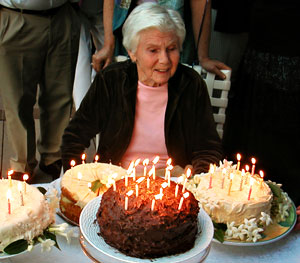
Obviously, the 90+ population boom is going to present some challenges: Swelling the ranks of already-strained Medicare and Social Security programs; increasing the need for geriatric doctors and others who can cater to the health needs of the oldest old. And what kind of 90-year-olds will we all be? Unless we can slow the rates of dementia and disability in our oldest old population, more and more people living to age 90 seems like a kind of grim proposition.
A key issue for this population will be whether disability rates can be reduced," said Richard Suzman, director of behavioral and social research at the National Institute on Aging.
Disability rates spike drastically around age 90, the NIA found. The share of people age 90-94 who report some kind of impairment-inability to do errands, visit a doctor's office, climb stairs, bathe themselves-stands at 82 percent, 13 percentage points higher than those 85-89 (69 percent). Among those 95 and older, the disability rate jumps to 91 percent.
This is also a group without a lot of resources. The median income in the 90+ population was $14,760, about half of which came from Social Security. And about 14.5 percent of the age group lived in poverty, compared to 9.6 percent of American ages 65-89.
Aging With Style-and Endurance: If only we could all age as gracefully as Carmen Dell'Orefice, the 80-year-old supermodel who's still working the runways. Dell'Orefice, who started modeling at 13 and made the cover of Vogue by 15, is not only beautiful-she's mighty resilient, too. Dell'Orefice lost most of her life savings to Bernie Madoff a few years back , which is, in part, why she's still working today. But though an exhibition in London is celebrating her life's work, Dell'Orefice says she'd rather not focus too much on the past; she's too busy with current runway and print work, anyway-though she does tire of "the bad designers who try to put me in leather pants that I'd never wear."
I'm a working woman of 80 trying to work out what the image I can project is," Dell'Orefice tells the UK Telegraph. "How I can do it with, you know, dignity."
Friday Quick Hits:
- The Social Security payroll tax cut is set to expire at year's end. The cut gave most Americans an extra $1,000 to $2,000 this year.
- The first of two installments of "Woody Allen: A Documentary" will premiere Sunday on PBS. The film's director spent a year and a half interviewing Allen, taking him from his earliest memories through his latest hit, "Midnight in Paris."
- Stem cells show promise at revitalizing damaged hearts.
- Authorities are re-opening a probe into actress Natalie Wood's 1981 drowning death.
- If Americans stay on our current path, 83 percent of men and 72 percent of women will be overweight or obese by 2020.
- And Congress slashed funding yesterday for the U.S. Department of Housing and Urban Development's program to develop housing for low-income individuals, including poverty-stricken seniors. Currently, according to an AARP study, there are 10 seniors waiting for every one unit of affordable housing.
Photo: Abby Lanes/Flickr/Getty Images